High-Voltage Living
The concept of mobile power isn't new, but the scale of energy available via modern EV platforms is unprecedented. While a traditional 12V lead-acid deep cycle battery might offer 100Ah (of which only 50Ah is usable to avoid damage), a standard EV battery pack ranges from 60kWh to 100kWh. This represents a massive reservoir of energy—enough to run a domestic refrigerator for weeks or a space heater for several nights.
V2L works by utilizing an onboard bidirectional inverter that converts High Voltage (HV) DC power from the traction battery into 120V or 230V AC power. For example, the Hyundai IONIQ 5 and Kia EV6 utilize the E-GMP platform to provide up to 3.6kW of continuous power through an internal outlet or an external adapter that plugs into the Type 2 charging port. This is a game-changer for those who previously relied on portable power stations like the Jackery Explorer or EcoFlow Delta, as the car itself is now the ultimate power bank.
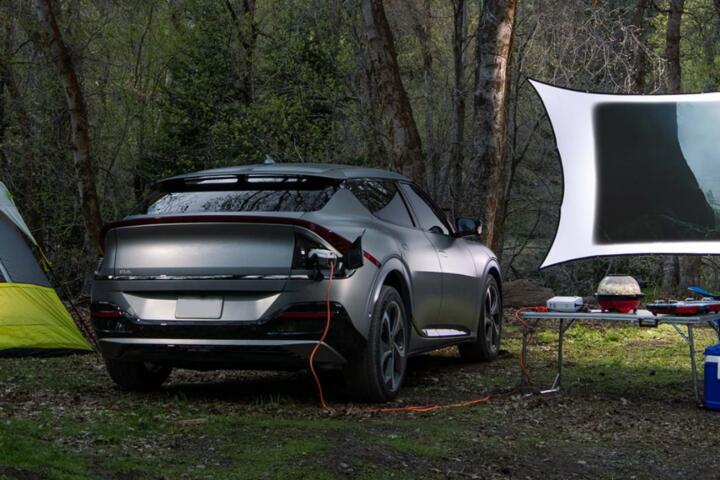
In practice, this means you can arrive at a remote campsite in the Gifford Pinchot National Forest and immediately plug in an induction cooktop, a Starlink dish, and a heated blanket without fearing a dead starter battery. The vehicle manages the conversion, and most systems allow you to set a "discharge limit" (typically between 20% and 80%) to ensure you never strand yourself.
Mobile Energy Errors
The most common mistake campers make is failing to account for "phantom drain" and the overhead energy cost of keeping the vehicle’s systems active. When V2L is engaged, the car's cooling pumps, thermal management systems, and onboard computers are often running. This can consume between 200W and 500W of power just to keep the "juice" flowing to your devices. If you are only charging a smartphone, you are wasting a massive amount of energy just to keep the inverter awake.
Another frequent failure point is the lack of surge protection for sensitive electronics. While the AC output from cars like the Ford F-150 Lightning is a pure sine wave, plugging in multiple high-draw appliances simultaneously can trip the internal breaker. If your coffee maker draws 1500W and your portable AC unit kicks in with a 2000W startup surge, the system will shut down. Resetting this often requires cycling the vehicle's ignition, which is an unnecessary annoyance in the middle of a rainstorm.
Lastly, users often overlook the environmental impact on battery chemistry. Running heavy V2L loads in sub-freezing temperatures (below 0°C) forces the vehicle to use its own energy to heat the battery pack to maintain discharge efficiency. In extreme cold, you might find that 30% of your used energy went to "self-preservation" rather than powering your gear.
Off-Grid Utility
Maximizing Efficiency with Induction and DC Gear
To get the most out of your battery, skip the propane stove and use a portable induction cooktop like the Duxtop 9600LS. Induction is roughly 85-90% efficient compared to gas. Furthermore, for refrigeration, avoid using "thermoelectric" coolers which run constantly. Instead, use a compressor-driven fridge like the Dometic CFX3 45. These units draw minimal power (approx. 1-2Ah per hour) and can be plugged directly into the car’s 12V DC outlet to avoid the conversion losses associated with the AC inverter.
Managing High-Wattage Climate Control
Heating is the biggest "battery killer." A standard 1500W space heater will drain 1.5kWh every hour it runs at full tilt. On a 77kWh battery, leaving a heater on all night (8 hours) could consume 12-15% of your total range. To mitigate this, use 12V heated blankets (like those from Ignik) which draw only 40-60W. If you must use a space heater, look for a ceramic model with a "low" setting of 400W to maintain a steady temperature without rapid cycling.
Utilizing Smart Monitoring and Hubs
Don't plug everything directly into the car's adapter. Use a high-quality, weather-rated power strip with built-in surge protection. For digital nomads, integrating a Starlink Mini into your setup is now viable via V2L. The Mini draws about 25-40W, making it a negligible load on a large EV battery. Monitor your consumption through the vehicle's "Energy Information" screen; cars like the Rivian R1T provide real-time wattage readouts for each outlet zone, allowing you to balance the load between the frunk, the gear tunnel, and the bed.
Seasonal Battery Conservation
In summer, park in the shade to reduce the energy the car spends on cabin overheat protection or battery cooling. In winter, if your EV has a heat pump (standard on many Tesla Model Y and Polestar 2 long-range trims), use the "Camp Mode" feature. This is often more efficient than running external heaters because the car's HVAC system is optimized to move heat rather than create it through resistance.
Redundant Charging for Long Stays
If you plan to stay at a site for more than four days, consider a "hybrid" approach. Use the V2L for high-draw tasks like cooking and power tools, but augment the system with a portable solar blanket like the REDARC 160W Monocrystalline. While you can't easily charge the main EV battery with portable solar, you can use it to keep a secondary "buffer" power station (like an Anker 757) topped up, reducing the frequency with which you need to wake up the car's V2L system.
Field Applications
Case Study 1: The Remote Content Creator
A freelance videographer used a Hyundai IONIQ 5 for a three-day shoot in the Mojave Desert. The setup included charging two DJI Mavic 3 drones, a MacBook Pro M2 Max, and a RED Komodo camera system.
- Challenge: High ambient heat and the need for constant 110V charging.
- Solution: They set the V2L limit to 30% and used the external V2L adapter to power a small EcoFlow Glacier fridge/freezer for crew hydration.
- Result: Over 72 hours, the vehicle battery dropped from 85% to 62%. They consumed roughly 17.7kWh, covering all equipment charging, refrigeration, and two nights of "Camp Mode" AC usage.
Case Study 2: The Winter Overlander
An adventurer took a Rivian R1T on a skiing trip, camping at the trailhead.
- Challenge: Maintaining a habitable cabin temperature in 10°C weather while powering an electric kettle and a heated gear bag.
- Solution: Utilized the truck’s internal bed outlets for the gear bag and the internal cabin HVAC for sleeping.
- Result: The R1T consumed roughly 15% of its 135kWh pack per night to maintain a 20°C cabin. By using a high-efficiency Jetboil for water and only using V2L for 10-minute bursts, they spent five days off-grid and still had 20% battery to reach a nearby Fast Charger.
Power Consumption Guide
| Appliance | Average Power Draw (Watts) | Estimated Usage per Hour | Best Practice |
|---|---|---|---|
| Induction Cooktop | 1000W - 1800W | 0.5 - 1.0 kWh | Use high heat for boiling, then drop to 300W. |
| Electric Kettle | 1200W - 1500W | 0.1 kWh (per boil) | Only boil the exact amount of water needed. |
| Compressor Fridge | 40W - 60W | 0.02 kWh | Keep the lid closed; pre-chill at home. |
| Starlink Dish | 50W - 75W | 0.07 kWh | Stow when not in use to stop searching for satellites. |
| Space Heater | 750W - 1500W | 0.75 - 1.5 kWh | Avoid if possible; use heated blankets instead. |
| Laptop (USB-C) | 60W - 100W | 0.08 kWh | Charge during the day when V2L is already active. |
| LED Camp Lights | 5W - 15W | < 0.01 kWh | Use built-in vehicle puddle/bed lights if available. |
Common Mistakes
- Ignoring the 12V Battery: Some older EVs or those with specific software versions (like certain Ford Mach-E builds) may struggle to keep the 12V accessory battery charged while the 110V V2L is active. If the 12V dies, the car won't start, even if the main pack is at 90%. Always ensure your vehicle is in "Ready" or "Camp" mode.
- Daisy-Chaining Cables: Using thin, household-grade extension cords causes voltage drops and heat buildup. Always use 12-gauge or 14-gauge heavy-duty outdoor extension cords to handle the 15A current typically supplied by V2L ports.
- Overestimating Range: Remember that 5kWh used for camping is 5kWh you don't have for driving. On average, 1kWh equals roughly 3-4 miles of range. If you use 20kWh at camp, you've effectively "shortered" your drive home by 60-80 miles.
- Leaving the V2L Adapter Plugged In: Some adapters have a physical switch. If left "on" without a load, the car’s contactors stay closed, causing a steady drain of roughly 200-400W as the vehicle stays awake.
FAQ
Can I use V2L while the car is charging at a station?
Usually, no. Most EVs like the Kia EV6 or VW ID.4 (with BiDi updates) prioritize the charging input. The hardware configuration typically prevents simultaneous AC output and DC/AC input.
Will using V2L significantly degrade my car's battery?
The "cycling" caused by camping is negligible compared to the stresses of driving. Drawing 2kW from a battery designed to output 200kW+ during acceleration is extremely low-stress.
What happens if it rains while the V2L adapter is plugged in?
Most OEM adapters, such as the Hyundai V2L Connector, are rated IP44 or higher, meaning they are splash-proof. However, you should never allow the connection point of your extension cord to sit in a puddle.
Does Tesla support V2L for camping gear?
Currently, only the Cybertruck officially supports robust V2L (branded as Powershare) with up to 9.6kW output. Other Tesla models require the use of the 12V (or 16V) accessory socket, which is limited to about 120W-180W.
Can I run a CPAP machine overnight using V2L?
Yes, and it is incredibly reliable. A CPAP typically draws 30W-60W. Even with inverter overhead, you would likely use less than 2-3% of your battery over an 8-hour sleep.
Author's Insight
In my three years of testing electric vehicles in the Pacific Northwest backcountry, I've found that the psychological shift is the hardest part. We are trained to conserve every watt-hour to avoid "range anxiety," but once you realize that a single burger cooked on an induction hob uses the same energy as driving only about 800 meters, you start to relax. My best advice: invest in high-quality DC-native appliances first. Every time you can avoid using the AC inverter by using a USB-C or 12V plug, you're extending your stay by hours. Efficiency at the "edge" (the appliance) is just as important as the capacity at the "core" (the car).
Summary
Maximizing the utility of your vehicle's battery for camping requires a strategic balance between high-wattage convenience and systemic efficiency. By prioritizing induction cooking, utilizing 12V heating solutions, and strictly monitoring discharge limits, you can turn your EV into a sophisticated mobile basecamp. Avoid common pitfalls like using low-quality extension cords or ignoring the energy overhead of the vehicle's "awake" state. The goal is to leverage the massive capacity of the traction battery to enhance comfort without compromising the ability to reach the next charging waypoint. Always check your vehicle’s specific discharge settings before heading out and ensure your gear matches the continuous output rating of your onboard inverter.