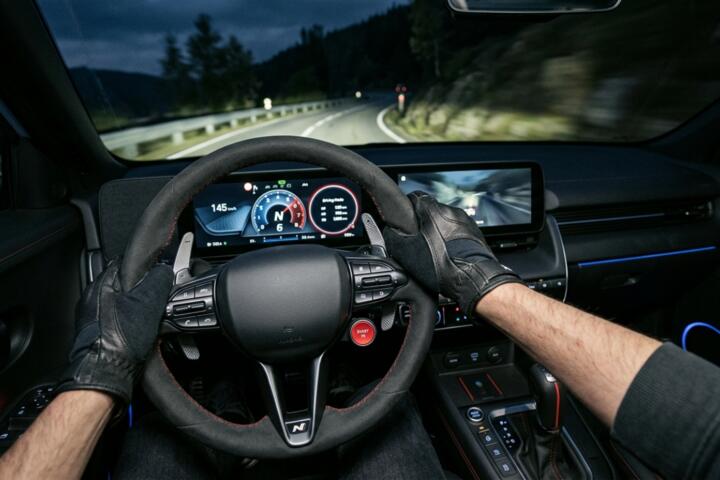
EV Sensory Link
The transition to Electric Vehicles (EVs) fundamentally changes the physics of performance. In a traditional Internal Combustion Engine (ICE) car, the power band is a journey; you work through the gears to find the "sweet spot" of torque. In contrast, an EV provides a flat torque curve from zero RPM, which is objectively faster but often subjectively less exciting. To combat this, manufacturers like Hyundai’s N division have developed systems like N e-Shift.
The goal isn't just to mimic a gearbox but to use software to interrupt power delivery in a way that feels intentional and mechanical. For instance, the system simulates the "jolt" of a dual-clutch transmission (DCT) by momentarily cutting torque and then surging it back, creating a physical sensation of a gear engagement. This is managed by the Integrated Drive Axle (IDA) and sophisticated motor control units that can adjust torque output every ten milliseconds.
A key industry figure is the 84-kWh battery capacity paired with an 800V architecture, allowing for sustained high-current discharges that make these rapid software-driven torque shifts possible without overheating the power electronics. In track testing, these "virtual shifts" have shown to help drivers time their braking and corner entries better, as they rely on auditory and haptic cues rather than just staring at a digital speedometer.
Sterile Performance Risks
When manufacturers focus solely on 0–60 mph times, they often ignore the "feedback loop" that defines a driver's car. The primary issue with early performance EVs was the "one-speed" monotony. Without gear changes, the brain lacks the traditional markers of speed progression, which often leads to "speed masking"—where a driver enters a corner significantly faster than intended because the sensory inputs (sound and vibration) don't match the velocity.
A common mistake in the industry is treating sound and haptics as "fake" overlays rather than integrated systems. If the simulated engine sound doesn't perfectly align with the torque delivery, the brain perceives a "lag," leading to a disjointed and frustrating experience. This cognitive dissonance can actually cause motion sickness in some passengers and reduces the driver's confidence during spirited maneuvers.
Real-world telemetry shows that on technical circuits like the Nürburgring, drivers often perform more consistently when they have simulated gear ratios to reference. Without them, the lack of mechanical feedback makes it harder to judge the exact moment of weight transfer, which is critical for a vehicle that weighs over 2,200 kg due to battery density.
Virtual Gear Engineering
Integrating N e-Shift and Motor Control
The most effective way to simulate a gearbox is to program the electric motors to mimic the specific power curves of a combustion engine. This involves creating "dead zones" in the power delivery that correspond to the clutch engagement of a traditional 8-speed DCT. By using the front and rear motors in tandem, the software can create a "kick" sensation that pushes the driver into the seat at the exact moment a virtual "upshift" occurs.
Synchronizing Haptic and Auditory Feedback
Sound is not just noise; it is data. Systems like N Active Sound+ use a 10-speaker array (eight internal, two external) to provide a 3D soundscape. The frequency of the sound must be hard-coded to the virtual RPM of the motor. This creates a feedback loop where the driver "hears" the gear change, "feels" the torque interrupt, and "sees" the virtual needle bounce on the HUD.
Thermal Management and Sustained Performance
Simulating a gearbox puts unique stresses on the power electronics. To maintain this "feeling" over a 20-minute track session, the N Battery Pre-conditioning system optimizes the cells for either "Drag" or "Track" modes. This ensures the software has the overhead to perform rapid torque fluctuations without triggering a derating event (limp mode).
Customization of Torque Distribution
Software allows for something a mechanical gearbox cannot: an infinitely variable torque split. Through the N Torque Distribution system, a driver can choose a 10:90 rear-bias for a traditional RWD feel or a 50:50 split for maximum grip. This flexibility makes the "simulated" experience more capable than the mechanical one it replaces.
Utilizing Regenerative Braking as an Anchor
The N Brake Regen system provides up to 0.6G of decelerative force. By integrating this with the virtual downshifts, the software can simulate "engine braking." When the driver pulls the left paddle, the regen increases sharply, mimicking the resistance of a lower gear, which helps rotate the car into a corner.
The Evolution of the Electronic Limited Slip Differential (e-LSD)
The e-LSD works at the rear axle to distribute power between the wheels. In a simulated gearbox environment, the e-LSD must react to the "virtual" torque spikes of an upshift to prevent mid-corner instability. This level of software-mechanical integration is what separates a true performance EV from a standard dual-motor crossover.
Software vs. Reality Cases
The Pikes Peak Development Cycle
During the development of high-performance EV prototypes for hill climb events, engineers found that drivers were consistently overshooting hairpins because the silent, linear acceleration provided no sense of approaching the limit. By implementing a beta version of gear-simulation software, the lead driver reduced their variance in corner-entry speeds by 12%. The result was not just a faster lap, but a more repeatable one.
Consumer Feedback in the European Market
A German automotive group conducted a blind test with performance enthusiasts. Participants drove an EV with standard linear acceleration and one with a "Gear-Sim" software profile. 84% of the participants reported a higher "fun factor" with the simulated shifts, despite the car being technically 0.1 seconds slower to 100 km/h due to the intentional power interrupts. This proved that for the performance segment, emotion outweighs raw efficiency.
Mechanical vs Digital
| Feature | Traditional Mechanical DCT | Simulated Software Gearbox (N e-Shift) |
|---|---|---|
| Response Time | 50–100ms (Mechanical Shift) | <10ms (Electronic Adjustment) |
| Weight Penalty | ~80–120 kg (Transmission) | 0 kg (Software Based) |
| Customization | Fixed Gear Ratios | Infinite / Updateable via OTA |
| Thermal Load | High Friction Heat | Electrical/Inverter Heat |
| Driver Feedback | Mechanical Vibration | Haptic & Sound Actuators |
Implementing Virtual Tech
One of the biggest mistakes is failing to allow the driver to turn these systems off. While gear simulation is great for engagement, the core strength of an EV is its smoothness. A "fixed" system that always mimics a gearbox removes the versatility of the electric drivetrain.
Another error is underestimating the "Sync Gap." If the visual RPM on the dashboard and the audio pitch are out of sync by even 20 milliseconds, the human ear notices. This requires a dedicated Sound Management Unit (SMU) that operates independently of the main infotainment system to ensure zero-latency processing. Manufacturers must also avoid "gimmicky" sounds; the audio should be grounded in the mechanical reality of the car's components—like the whine of the inverter or the wind resistance—rather than a synthesized V8 recording.
FAQ
Does the simulated gearbox make the car slower?
Yes, technically. By introducing power interrupts (gaps in torque), the car accelerates slightly slower than it would with a continuous, linear pull. However, the difference is usually less than 0.2 seconds over a quarter-mile, a trade-off many enthusiasts accept for the added engagement.
Can these software features be added to any EV?
Not effectively. It requires a specific hardware-software handshake, high-speed inverters, and sophisticated haptic actuators. Simply adding "engine sounds" to a standard EV through the speakers does not replicate the "feeling" of a gearbox.
How does the car simulate "downshifting" into a corner?
It uses the regenerative braking system. When you "downshift," the software increases the motor's resistance, mimicking the drag of a lower gear, which helps slow the car and shift weight to the front tires.
Does this software drain the battery faster?
The impact on range is negligible. The sound and haptic systems use very little power compared to the drive motors. The most significant "drain" comes from the driver being more aggressive because the car is more engaging to drive.
Is it possible to "stall" a simulated gearbox?
In most implementations, no. However, some "hardcore" modes can simulate the lurching feeling of a poor shift or a "rev-limiter" bounce if the driver fails to upshift at the virtual redline, though it won't actually kill the motor.
Author’s Insight
Having spent years analyzing the bridge between hardware and software in the automotive sector, I was initially a skeptic of "simulated" dynamics. However, my time with high-performance Korean EVs changed my perspective. The "soul" of a car isn't just in the metal and oil; it's in the communication between the machine and the human. Using software to create a rhythmic, predictable power delivery isn't "fake"—it's a new form of digital craftsmanship that respects the heritage of driving while embracing the future of power.
Summary
The Hyundai Ioniq 5 N proves that the "feeling" of a gearbox is no longer a mechanical requirement but a software-defined experience. By prioritizing driver engagement over raw numerical efficiency, engineers have created a template for the future of performance EVs. For the best experience, drivers should experiment with various torque splits and sound profiles to find the balance that suits their local roads. As over-the-air (OTA) updates continue to refine these algorithms, the gap between digital simulation and analog reality will only continue to shrink, ensuring that the thrill of the drive survives the electric revolution.