Science of Surface Bonds
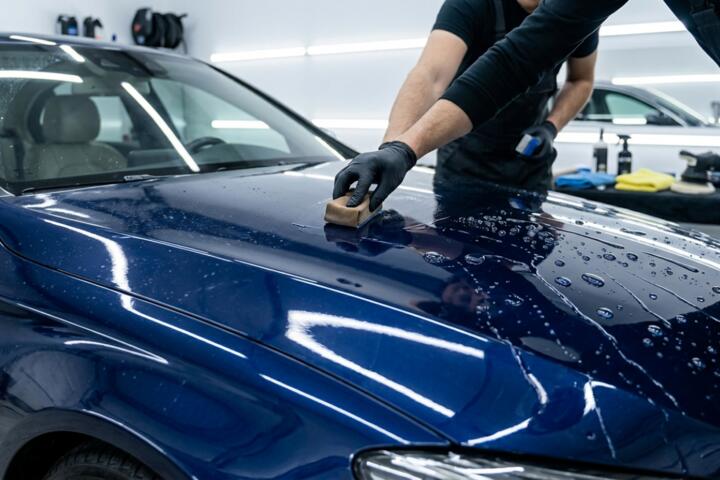
At its core, a high-performance coating is a liquid polymer that transforms into a solid, transparent layer of ceramic upon curing. Unlike traditional carnauba wax, which sits on top of the paint, these coatings utilize a carrier solvent to help nanoparticles penetrate the pores of the clear coat. The primary ingredient is typically Silicon Dioxide (SiO2), often sourced from quartz or sand, which provides the characteristic hardness and gloss.
In professional detailing shops like ESOTERIC or Topaz Detailing, the focus is on cross-linking. When the coating is leveled, the molecules form a dense, three-dimensional matrix. This structure is significantly harder than the factory paint, often measuring above 9H on the pencil hardness scale. For reference, a standard automotive clear coat usually falls between 2H and 4H, making the ceramic layer a formidable sacrificial barrier.
Real-world data shows that a well-applied coating can reduce surface friction by up to 60%. This slip-factor is why dirt and water struggle to adhere to the surface. In a 2024 laboratory test, surfaces treated with high-solids SiO2 showed 95% less chemical spotting when exposed to simulated acid rain compared to untreated panels.
Preservation Failures
Inadequate Decontamination Rituals
The most frequent mistake is applying a $100 bottle of coating onto a $5 surface. Even if a car looks clean, embedded metallic particles from brake dust and industrial fallout remain in the paint pores. If these aren't removed with an iron-remover and a clay bar, the ceramic bonds to the contaminants rather than the paint. This leads to premature "patchy" failure where the coating peels off in microscopic flakes within months.
The Myth of "Scratches-Proof"
Marketing teams often oversell the hardness of these products. While a coating is "scratch-resistant," it is not "scratch-proof." Users often switch to aggressive, dry-wiping habits or automated brush car washes, believing the coating will protect them. The result is a spider-web of swirl marks that are now trapped *under* or *within* a semi-permanent layer, requiring heavy machine polishing to fix.
Ignoring the Flash Point
Every coating has a "flash time"—the window where the solvents evaporate and the product begins to bond. Applying ceramic in high humidity or direct sunlight accelerates this process. If you wait too long to buff away the residue, you get "high spots" or dark streaks. Once cured, these streaks can only be removed by abrasive leveling, essentially wasting the product and your time.
Application Strategies
Multi-Stage Paint Correction
To achieve the "wet look," the surface must be optically flat. This involves using long-throw dual-action polishers like the Rupes LHR15 Mark III. By removing 3-5 microns of clear coat to eliminate defects, you create a mirror finish that the ceramic then "locks in." Professional results require a surface that is 99% defect-free before the first drop of liquid hits the applicator.
Chemical Solvent Stripping
After polishing, the paint is covered in lubricating oils. A coating will not bond to oil. Using a high-concentration Isopropyl Alcohol (IPA) solution or a dedicated panel prep like Gtechniq Panel Wipe is mandatory. This ensures the SiO2 molecules have direct access to the clear coat's molecular structure, increasing the lifespan of the protection from 1 year to 5+ years.
The Layering Logic
Many high-end systems, such as Ceramic Pro or Gtechniq Crystal Serum Ultra, rely on a base coat and a top coat. The base coat provides the rigid, hard structure, while the top coat (often containing Fluorine) adds extreme hydrophobicity and slickness. This "stacking" method ensures the vehicle stays cleaner for longer, as the contact angle of water droplets often exceeds 110 degrees.
Infrared Curing Techniques
While most coatings air-cure in 24 hours, top-tier studios use short-wave Infrared (IR) lamps. Baking the coating at 60°C for 15 minutes per panel forces the solvents out and accelerates the cross-linking process. This results in a denser, glossier finish and allows the customer to take the car out into the rain immediately, rather than waiting for a full day of dry weather.
Strict Maintenance Washing
To preserve the coating, you must use pH-neutral shampoos like CarPro Reset. Standard soaps often contain waxes or "gloss enhancers" that clog the pores of the ceramic, making it look like the coating has failed. A dedicated ceramic maintenance spray (containing Sio2) should be used every 3-4 months to "top up" the sacrificial layer and maintain the self-cleaning properties.
Real-World Performance
Fleet Management Success
A luxury rental fleet in Dubai applied a professional-grade ceramic coating to 20 white SUVs. Before the coating, the vehicles required professional polishing every 6 months due to sand abrasion and UV oxidation. After the application of a 9H ceramic layer, the fleet maintained a "like-new" gloss for 18 months with only basic touchless washing. The company reported a 40% reduction in aesthetic maintenance costs over two years.
Classic Car Preservation
A collector with a 1960s Porsche 356 utilized a low-solvent ceramic coating to protect the original single-stage paint. Unlike modern clear coats, single-stage paint is highly porous and prone to oxidation. The coating sealed these pores, preventing the red pigment from turning chalky pink. Three years later, the paint depth measurements remained identical, proving that the coating halted the natural degradation of the vintage lacquer.
Protection Comparison
| Type | Specs (Durability/Hard) | Resistance | Complexity |
|---|---|---|---|
| Carnauba Wax | 4-6 Weeks / <1H | Poor / Low Heat | Very Easy |
| Polymer Sealant | 4-6 Months / 1H | Moderate | Moderate |
| Pro Ceramic | 2-5 Years / 9H+ | Excellent (pH 2-13) | Professional |
Common Pitfalls
Skipping the Test Spot
Different paint systems (soft Japanese paint vs. hard German ceramic clears) react differently to coatings. Professionals always test a small area on a lower rocker panel first. If the coating "sweats" or disappears too quickly, it indicates the paint is highly porous or the temperature is too high. Ignoring this leads to a "grabby" application that is nearly impossible to level smoothly.
Using Dirty Microfibers
Ceramic coatings are sensitive to cross-contamination. Using a towel that has remnants of old wax or polish will cause the coating to smear. We recommend a "three-towel system" for removal: one for the initial wipe, one for the secondary leveling, and a final ultra-plush towel for the buff. Once a towel is used for ceramic removal, it should be discarded or used only for wheels, as the cured ceramic crystals will turn the fibers abrasive.
FAQ
Does ceramic coating stop rock chips?
No. While it adds hardness, it is much too thin (usually 1-2 microns) to absorb the energy of a high-speed stone impact. For rock chip protection, you must use Paint Protection Film (PPF), which can then be coated with ceramic for gloss and hydrophobicity.
Can I apply ceramic over an old wax?
Absolutely not. The coating will bond to the wax instead of the paint. When the wax naturally wears off in a few weeks, the ceramic coating will fall off with it. The surface must be chemically pure before application.
How do I know if the coating is still working?
The easiest indicator is water behavior. If water sheets off the surface or forms tight, tall beads that roll off at low speeds, the coating is active. If water "pools" or stays flat, the coating is either clogged with dirt or has reached the end of its life.
Is it safe for matte or satin finishes?
Yes, but you must use a specific "Matte" version of the coating. Standard coatings often contain gloss enhancers that will ruin the flat look of matte paint. Specialized matte coatings provide UV protection and water beading without adding unwanted shine.
Can I wash my car immediately after coating?
No. Most coatings require a 7-day window before they are fully chemically resistant. During this first week, you should avoid any soaps or chemicals. If the car gets dusty, a light rinse with plain water is acceptable, but avoid high-pressure sprayers.
Author’s Insight
In my fifteen years of detailing, I’ve seen the industry move from "smoke and mirrors" to genuine chemical engineering. The biggest shift isn't the products themselves, but the prep work. I always tell my clients that the coating is only as good as the person holding the polisher. If you're doing this at home, spend 80% of your time on the wash and polish, and only 20% on the coating application. A properly prepped surface makes the actual ceramic bonding effortless and ensures you get the full five years of performance you paid for.
Summary
High-performance ceramic coatings represent the pinnacle of current surface science, offering a blend of SiO2 and TiO2 technologies to safeguard automotive investments. To maximize these benefits, prioritize mechanical decontamination and multi-stage polishing before application. Once the coating is cured, maintain it with pH-neutral chemicals and avoid abrasive contact. By following these professional protocols, you ensure a finish that isn't just visually stunning, but molecularly fortified against the elements.